How Agentic AI Becomes the Urban Decision-Maker
Over the past few articles, we progressively moved up the intelligence stack in urban analytics:
- AI in urban planning: showed how data-driven models improve forecasting and infrastructure design.
- Road condition standards & metrics: established measurable ground truth for infrastructure quality.
- Object detection in road safety: enabled perception (what exists in the scene).
- Beyond the image: Agentic AI: introduced reasoning (why something matters and what to do next).
Now we reach the natural next step:
Cities don’t need more dashboards.
Cities need systems that act.
This article explains how advanced Agentic AI transforms urban planning from analytical to operational: from observing cities to continuously managing them.
1. The Missing Layer in Urban Planning: Decision Latency
Traditional planning operates in long cycles:
| Phase | Typical Duration |
|---|---|
| Data collection | Months |
| Analysis | Weeks |
| Policy drafting | Months |
| Implementation | Years |
Meanwhile, cities evolve hour-by-hour.
- Traffic patterns shift after a new shopping center opens.
- Cyclist routes change after a near-miss intersection incident.
- A construction site degrades pavement months before inspection.
The core problem is not lack of data anymore, modern cities produce petabytes.
The problem is decision latency.
Urban intelligence today works like this:
Sensors → Reports → Experts → Committees → Actions
Agentic systems change it to:
Sensors → Understanding → Decision → Action → Verification → Learning
This is not faster analytics. This is continuous governance.
2. From Perception AI to Agentic AI
Let’s position the evolution clearly.
Stage 1: Detection AI (Perception)
Detects objects and events.
- Car
- Pedestrian
- Pothole
- Traffic light state
This answers: “What exists?”
Stage 2: Analytical AI (Interpretation)
Correlates multiple observations.
- Congestion probability
- Risk scoring
- Level-of-service estimation
- Pavement deterioration trend
This answers: “What does it mean?”
Stage 3: Agentic AI (Autonomous Planning)
Acts toward a goal under constraints.
- Adjusts signal timing
- Re-routes transit dynamically
- Schedules inspections
- Dispatches maintenance
- Modifies policy thresholds
- Simulates intervention outcomes
This answers:
“What should be done right now?”
Agentic systems differ from automation because they plan, evaluate outcomes, and adapt instead of executing predefined rules.
3. Urban Planning Becomes a Continuous Control System
Historically, cities were designed like architecture.
Agentic cities operate like cyber-physical systems.
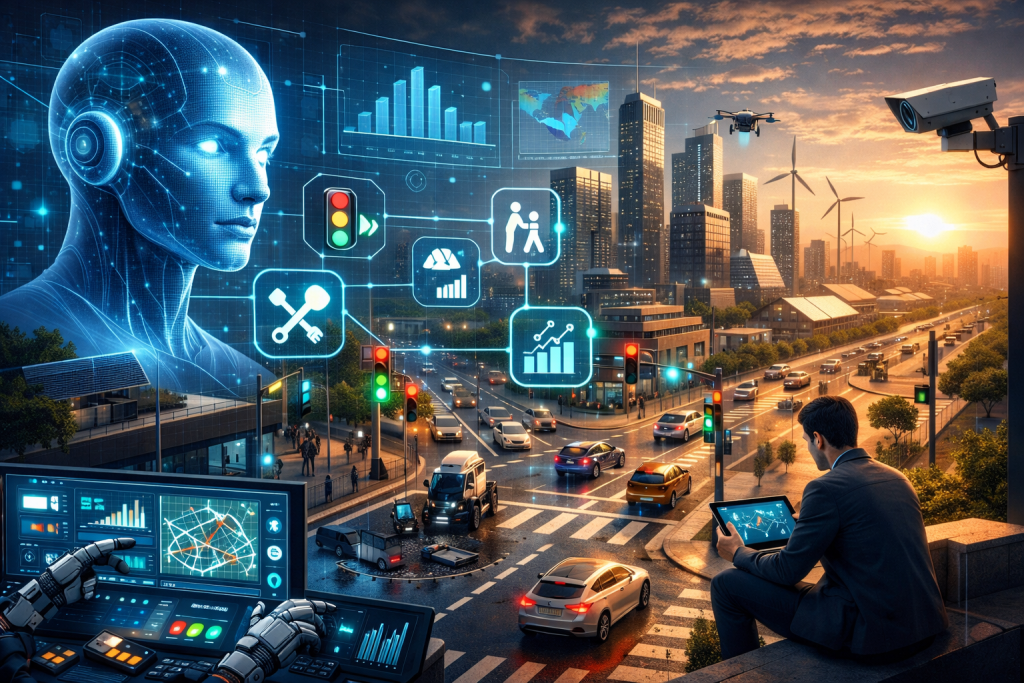
The New Urban Control Loop
- Sense: multimodal sensors, cameras, IoT, maps
- Understand: scene semantics & risk context
- Predict: short-term future state
- Decide: policy-bounded optimization
- Act: infrastructure adjustment
- Validate: observe effect
- Learn: update strategy
This is effectively Model Predictive Control for cities.
Urban planning stops being periodic and becomes perpetual.
4. Practical Urban Planning Applications
A. Dynamic Road Safety Planning
Instead of waiting for crash statistics:
Agentic system observes:
- frequent hard braking
- near-miss trajectories
- nighttime visibility drop
- pedestrian hesitation behavior
Then it autonomously:
- reduces speed limit during risk windows
- increases signal clearance interval
- flags curb redesign
- schedules lighting upgrade
- recommends protected crossing installation
The planner now reviews a validated intervention, not a hypothesis.
B. Infrastructure Maintenance Becomes Predictive Operations
Current method:
Inspect → Find → Budget → Fix
Agentic method:
Detect deterioration → Predict failure → Optimize repair timing → Dispatch crew → Confirm improvement
The system balances:
- safety risk
- traffic disruption
- repair cost
- long-term lifecycle cost
This is essentially asset management + operations research + AI autonomy.
C. Real-Time Zoning Feedback
Cities traditionally zone using static assumptions.
Agentic planning can dynamically analyze:
- footfall heatmaps
- curb usage conflicts
- delivery dwell time
- micro-mobility clustering
- noise & emissions patterns
Then recommend:
- curb regulation changes
- loading zone relocation
- pop-up transit priority
- temporary pedestrianization
Urban policy becomes experimentally adaptive rather than politically irreversible.
D. Autonomous Transit Optimization
Rather than planning bus routes annually: The system continuously adjusts:
- stop spacing
- signal priority windows
- fleet allocation
- headway control
- detour routing
The result: Public transport behaves closer to a responsive network than a fixed timetable.
5. The New Role of Urban Planners
Agentic AI does not replace planners. It changes their abstraction layer.
| Old Role | New Role |
|---|---|
| Design solutions | Define objectives |
| Analyze reports | Validate policies |
| Manual simulations | Govern constraints |
| Post-incident response | Pre-incident prevention |
| Static regulations | Adaptive regulation frameworks |
Planners move from engineering infrastructure to engineering behavior of systems.
They define:
- safety tolerance
- equity constraints
- environmental targets
- acceptable automation authority
The AI executes within governance boundaries.
6. Governance: The Critical Component
Agentic urban systems must operate under explicit policy guardrails:
Required Urban AI Constraints
- No discriminatory optimization
- Safety priority over efficiency
- Human override hierarchy
- Transparent decision logs
- Simulation before deployment
- Measurable intervention outcomes
Without governance, autonomy becomes unpredictable.
With governance, autonomy becomes scalable public service.
7. Toward the Autonomous City
We are entering a new paradigm:
Smart City → Cognitive City → Autonomous City
A smart city observes.
A cognitive city understands.
An autonomous city manages itself within human policy.
Agentic AI is the operational layer that enables this transition.
Conclusion
Urban planning has historically been constrained by time:
plans were static because decisions were slow.
But cities are dynamic organisms.
Agentic AI introduces a new capability: continuous, accountable intervention.
Not replacing human planning, but executing it persistently at machine timescales.
The planner sets intent.
The city implements it.
And for the first time, infrastructure policy can operate at the same speed as urban life itself.
If earlier AI helped cities see,
and analytics helped cities understand,
Agentic AI finally allows cities to act responsibly and continuously.