
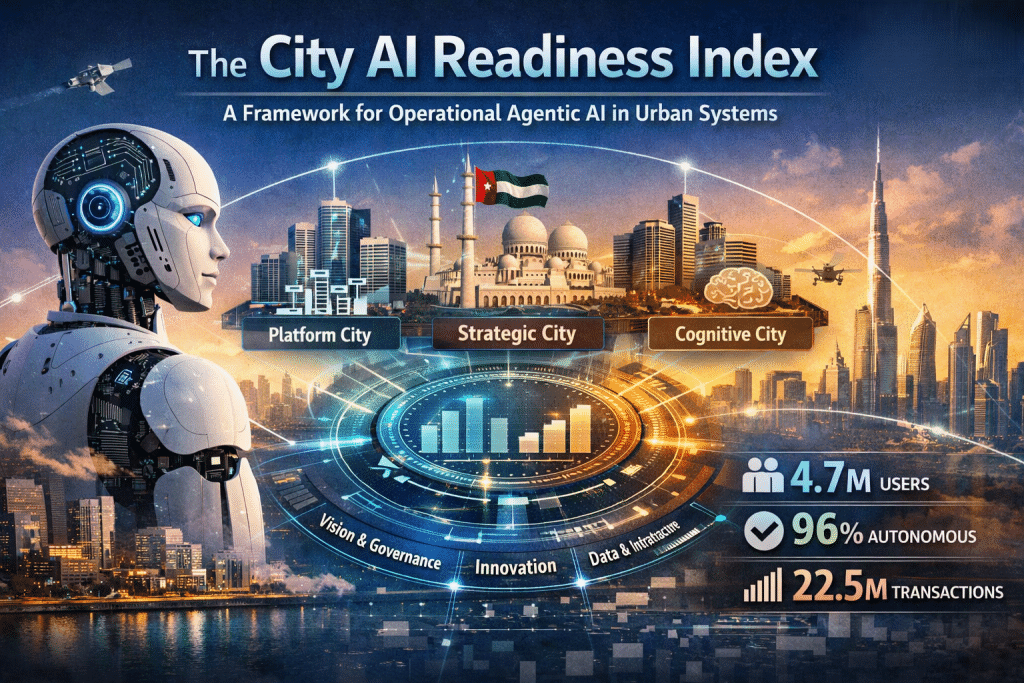
A Framework for Operational Agentic AI in Urban Systems
Powering Thinking Cities Through Spatial Intelligence.
Key Takeaways
- Oxford Insights published a framework proposing the City AI Readiness Index on October 6, 2026.
- The framework uses six pillars and four archetypes to benchmark city readiness.
- Abu Dhabi serves as the Strategic City case study.
- TAMM platform reaches 4.7 million users with 96% autonomous resolution.
- The index will pilot across 15 to 20 cities before global rollout.
- JimaTech’s spatial intelligence loop aligns with the index’s governance pillars.
The Problem: Cities Deploy First, Measure Later
The City AI Readiness Index addresses a key gap. National governments have used the Government AI Readiness Index since 2017. But city AI work lacks a clear benchmark. Most people deal with government at the city level. Cities use computer vision, predictive models, and agentic platforms, the kind that act on their own. No shared benchmark exists.
The study looked at six cities. Abu Dhabi was the main case. Seoul, London, Montreal, Helsinki, and Tallinn were also part of the study. Cities are moving fast. But no common benchmark exists to compare them.
Six Pillars and Four Archetypes
The six pillars are:
- Vision & Governance
- Innovation Culture
- Innovation Ecosystem
- Funding & Financing
- Human Capital
- Data & Infrastructure
These pillars showed similar results. But local factors and choices led to different paths. So the research finds four archetypes:
Platform City: infrastructure-led, building the compute and data layer first
Strategic City: AI as a key national or global differentiator
Delivery City: service-focused, using AI as an urban delivery toolkit
Cognitive City: research-driven, based in academic institutions
Abu Dhabi and Seoul fall into the Strategic City category. This grouping shows what a city optimizes for and where blind spots may lie.

Abu Dhabi: The Strategic City Case Study
Abu Dhabi launched a three-year strategy in January 2025. Its goal is to be the first AI-native government by 2027. A national cloud provides compute. The Stargate UAE data centre is a $30 billion project by G42. OpenAI and Oracle help run it. Its first phase starts in 2026. Hub71+ AI launched in December 2024 to link startups to capital, compute, and partners. Talent comes from Mohamed bin Zayed University of Artificial Intelligence and Khalifa University. Both helped with the report.
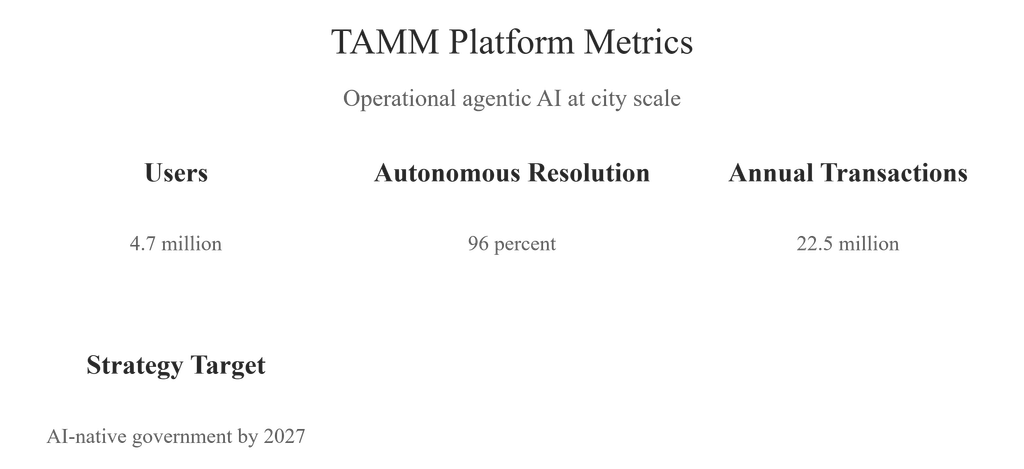
The result is visible in TAMM. TAMM is Abu Dhabi’s agentic AI-powered public services platform, the kind that acts on its own. It serves 4.7 million users and resolves 96 percent of questions on its own. In the twelve months to September 30, 2026, it processed over 22.5 million transactions. So it runs at city scale in production.
The Abu Dhabi AI Public Value Chain
The Abu Dhabi AI Public Value Chain has four layers. This structure shows how foundations become public services.
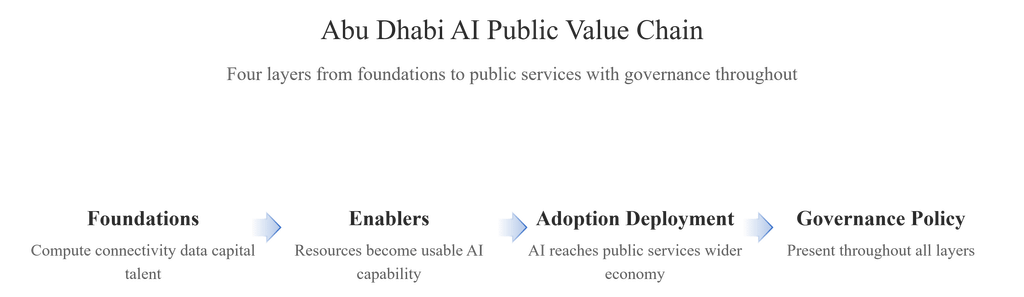
Governance and policy run through all layers instead of being only at the top. So responsibility must be built into the foundations, not added later.
Why This Matters for Thinking Cities
JimaTech’s motto is “Powering Thinking Cities Through Spatial Intelligence.” This means moving past dashboards to working Agentic AI systems, the kind that act on their own. The Sensory, Understand, Predict, Decide, Act, Validate, and Learn loop helps cities collect data and act with care.
The City AI Readiness Index fixes a checks gap. When cities rush and skip the Validate and Learn steps, this gap appears. For example, a Platform City may have strong compute but weak checks. A Delivery City may ship services fast but lack checks. Research-driven cities may produce research but find it hard to apply it. So the index makes these choices clear.
For example, this links directly to work on pavement intelligence. We discussed this in “Building Location-Aware Pavement Intelligence for Thinking Cities.” Computer vision detects damage. GIS provides location context. But treatment advice still needs a checks framework. So the readiness index helps measure that framework.
This also links to road safety topics. We covered these in “Beyond the Image: Why Road Safety Needs Agentic AI” and “Object Detection and Its Role in Road Safety.” Detection is the Sensory step. So the index asks whether the city has the Vision & Governance pillar to make sure detections lead to actions with care.
From Self-Assessment to Global Benchmark
Oxford Insights already has a Trustworthy AI Self Assessment and AI Readiness Conversations. So the City AI Readiness Index builds on them to create a global benchmark. The plan is to pilot across 15 to 20 cities, then expand.
CEO Richard Stirling put it this way: “Cities are where most people deal with government, yet there has been no shared way to judge how ready they are for AI. Our framework will give city leaders that information, and Abu Dhabi was the right place to test it. It has assembled every layer of the AI stack, from compute and energy through models and capital to government as a large-scale user. Applying the framework to other cities then shows the different routes they are taking and what each one relies on.”
For city engineers and leaders, the index helps with planning and buying. If a city scores low on Data & Infrastructure but high on Vision & Governance, the main task is clear. If Funding & Financing leads but Human Capital falls behind, risk rises. So teams can act on key gaps.
What Comes Next
The pilot will test if the six pillars work across different laws, budgets, and government types. It will also test the city type model against cities that do not fit well, including mixed cases from more than one type.
For specialists, the value is the framework itself. You can apply the six pillars to your city or project today. Map compute, data, talent, and checks against the Abu Dhabi value chain. Identify your target city type. Then ask: where is the responsibility layer?
The index does not replace rules for model checks, data quality, or system safety. Instead, it sets the city setting for those rules. For example, a model tested in a Strategic City with strong compute and checks may act differently in a Delivery City with limited checks and split data.
FAQ
What is the City AI Readiness Index? The City AI Readiness Index is a new global benchmark from Oxford Insights. It measures how prepared cities are to deploy Agentic AI, the kind that acts on its own, with care. It uses six pillars and four archetypes to evaluate city readiness.
Which cities were studied for the index? The initial study covered six cities. Abu Dhabi was the primary case study. The study also included Seoul, London, Montreal, Helsinki, and Tallinn.
How can city leaders use this framework? City leaders can use the six pillars to assess their current readiness. They can identify gaps and prioritize investments. The framework also helps with buying decisions and risk assessment for AI deployments.
References
- Oxford Insights: City AI Readiness: A Deep Dive into Abu Dhabi and the Global Landscape
- Oxford Insights: Government AI Readiness Index 2025
- JimaTech: From Smart Cities to Thinking Cities
- JimaTech: Building Location-Aware Pavement Intelligence for Thinking Cities
- JimaTech: Beyond the Image: Why Road Safety Needs Agentic AI
- JimaTech: Object Detection and Its Role in Road Safety
- JimaTech: Understanding Road Condition Standards and Metrics
- JimaTech: The Importance of Artificial Intelligence in Urban Planning
- Oxford Insights: AI Readiness
A world where data and AI enable better decisions across the systems that serve society.